

António Lobo Antunes
(1942-2026)
Every time a great writer dies, I feel that humanity has lost a piece of itself. There is a void. I am always overcome with sadness. Some people should live forever, it’s as simple as that.
‘The Land at the End of the World’ (2011 translation by Margaret Jull Costa) was one of the first novels we read for our Book Club. I had wanted to read António Lobo Antunes for a long time, but I had never had the courage. I was afraid of both the man, with his harsh image, and his writing. I was afraid of not being able to get into his stream of consciousness, and what would that say about me as a reader? How we sometimes stop ourselves from experiencing life. Giving up on reading a writer like António Lobo Antunes without even trying…
And then I read ‘The Land at the End of the World’ and was hooked from the first paragraph. It goes like this:
What I liked most about the zoo was the skating rink beneath the trees and the tall black instructor gliding backwards over the cement in slow ellipses without moving a single muscle, surrounded by girls in short skirts and white boots who, if they spoke, must surely have had voices as gauzy as those that announce departing flights in airports, syllables of cotton dissolving in the ears like threads of spun sugar on the shell of the tongue.
It would have been a shame, really, to miss out on reading António Lobo Antunes. I should simply have read that first paragraph so many years ago.
Rereading some of the passages I had underlined during that reading, I cannot help but think of what Milan Kundera said about the Art of the Novel. In his opinion, the Novel (or, in his view, the “great novels”) is the art form of choice for understanding human existence. Another paragraph of the same book by António Lobo Antunes reads:
Sentimentality, you know how it is, often takes the place in me of a genuine desire to change, and I go on wounding people imperturbably in the name of that peculiar kind of self-pity and remorse which most of the time assumes the form of a fierce egoism.
What is António Lobo Antunes’ writing if not a shameless immersion in human existence?
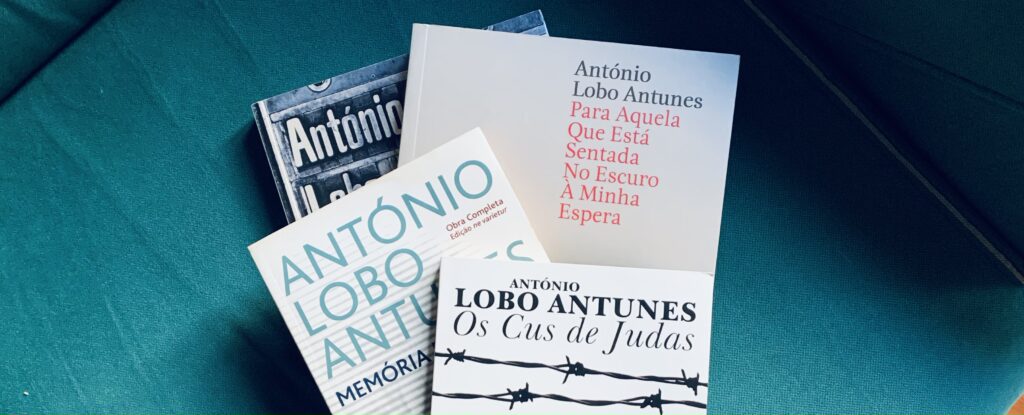
This week, we will put aside our Book Club project and read António Lobo Antunes, in his honour.
 English
  Portuguese
  French