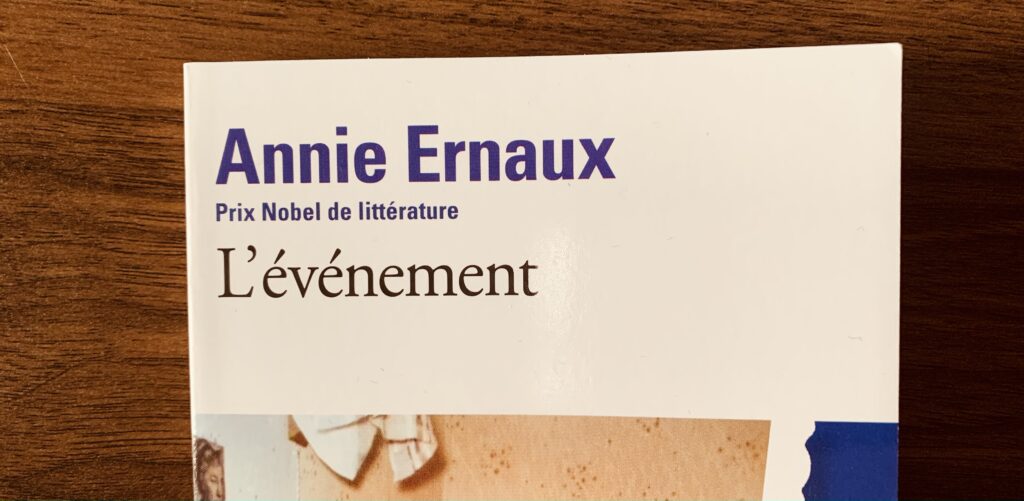
It was a coincidence, but on International Women’s Day we couldn’t have chosen a better book to discuss in my Book Club than Annie Ernaux’s ‘The Event’. At one point, one of us even said that we were discussing the subject of the book rather than the book itself as a work of literature. In fact, in Annie Ernaux’s book, we experience first-hand, from beginning to end, the event that marked her life as a young university student: an abortion. And not just any abortion, but a clandestine abortion in the early 1960s when abortion was illegal in France and the rest of Europe. In ‘The Event’, Annie Ernaux makes us experience her anguish from the moment she decides to have an abortion. There is a general lack of solidarity, both from those close to her and from health professionals, there is despair in the search for a solution because all possible doors are closed, and there is a desperate loneliness. And that loneliness is a female loneliness. The man involved not only does not care about the situation, but also does not try to help in any way. The same can be said about healthcare professionals who, at the time, could be punished with imprisonment and banned from practising medicine again. The book includes an excerpt about the penalties imposed at the time: all healthcare professionals involved, including pharmacists, and the woman were punished, but the man was not mentioned in the law.
But Annie Ernaux’s story remains relevant today. As we discussed in the group today, despite the legalisation of abortion in many European countries, the decision and procedure to terminate a pregnancy remains difficult for women. In a 2023 article in Diário de Notícias, Fernanda Câncio denounced the difficulties in accessing abortion, which constitutes a violation not only of that right, but also of the right to health. Sometimes the violation of a right is structural, but it is still a violation. For example, when the health system is ineffective, the result is a violation of a right. When a professional tries to delay a process so that, in the end, the woman does not have an abortion, this is a violation of a right. The same article reported that ‘In a situation identical to that in Portugal, Italy, where 35% of hospitals do not perform abortions (in Portugal the figure is 30%), (had been) condemned by the European Committee of Social Rights for violating the right of access to health and discrimination.’ In other words, abortion was legalised several decades ago, but the exercise of this right is still conditional and unequal. Therefore, in Portugal (and other European countries), women’s right to abortion is not a right that is fully respected.
Women bear the blame for humanity’s sins, while men’s guilt is non-existent, even today.
It is easy to denounce the situation of girls and women in Afghanistan. It is easy to point out that in European countries, such as Poland, abortion is still illegal. But the harsh truth is that in most countries, women do not have the same status as men in society. With a few exceptions, women, even in societies considered to be more advanced, continue to be the target of structural and cultural discrimination. Even in our countries, girls and women continue to experience absolutely unacceptable situations, and there is no real public debate about this systematic and ongoing discrimination.
We have shared so many examples in the short time we have spoken today. Examples that each of us has experienced: discrimination in a job interview, sexual harassment at work and by teachers in education, the fear that women live with when they find themselves walking alone at night, or the fear they feel when they have a stranger in their home fixing the plumbing or installing something. Women’s fear is not exaggerated; each of us has a story to tell. What is questionable is that we are still second-class citizens. Or as Annie Ernaux wrote:
“(…) it was impossible to determine whether abortion was prohibited because it was wrong, or whether it was wrong because it was prohibited. We judged in relation to the law, not the law itself.”
The law reflects cultural habits. We must denounce, question, reflect and discuss habits of discrimination that are so ingrained that we forget about them.
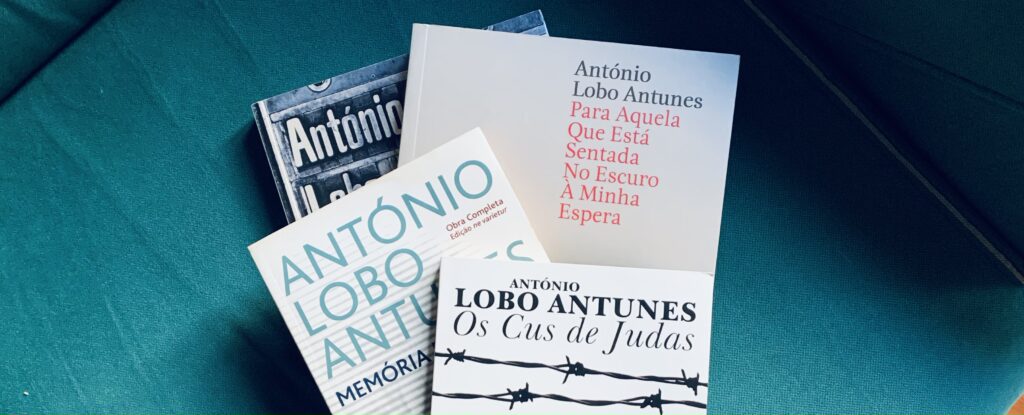
And we need to talk more about the role of women in society. This week, following the death of António Lobo Antunes, I read in one of his interviews that when someone is ill or on the verge of death, it is their mother they call for. Women literally carry life within them and, for that reason alone, women feel and experience emotions and feelings that are difficult for men to experience. I am surrounded by absolutely extraordinary women, friends, mothers, dream makers, carers. It is women who create, give birth and continue to care for all children, at home, in the education system and in social work. Humanity must open up and embrace the differences between men and women. We must (co-)build a truly shared society, try to learn from each other, as we do in couples or between parents and children. And we must begin by admitting the inconsistencies in society, the discrimination and injustices that women still suffer today.
 English
  Portuguese
  French