Shortly after What I Loved was published, when I was still in my early twenties, someone lent me what would turn out to be my first book by Siri Hustvedt. It was love at first read. What I Loved is the book I have recommended and given as a gift more than any other to date, and I have never stopped following the author’s work. Siri Hustvedt is, in fact, the only ‘famous person’ I follow and admire from afar on a regular basis. The only book I have ever pre-ordered before its release was her Ghost Stories, in which she mourns and shares her story of life and love with her husband, the late writer, poet and filmmaker, Paul Auster.
This year, twenty years on, I reread What I Loved for my Book Club. I realised immediately why Siri Hustvedt, the author and the woman, fascinated me so much and still does: her powers of observation and storytelling are simply extraordinary. Siri Hustvedt was, in her husband’s words, “the most intellectual in the family”. I am fascinated by her ability to observe, analyse and find words for every gesture, every emotion and wonder (good and bad) of human life. Her vocabulary seems limitless.
At the same time, the love between Siri Hustvedt and Paul Auster was what, viewed from a distance, seemed to me to come closest to the love I was seeking and for which, unlike the author, I have never been able to find the words. Recently, whilst reading Ghost Stories, I confirmed this suspicion of mine. In my view, love as I imagine it—let’s call it love between ‘soulmates’—is one of the most powerful and wonderful feelings that exists. The love described by Siri Hustvedt is genuine, in the sense that it does not claim to be idealistic or perfect, but rather true. We know and see the other person just as they are; we may not like some of their traits, but they too are part of the whole. There is a ‘me’, there is a ‘you’, but there is also (or above all?) a ‘us’, which is built over time, through complicity, sharing, friendship and the experience of good times and those in which we suffer greatly. I think that one of the pillars of this love is admiration. I think it is admiration that keeps that flame alive within us, that makes us feel, over time, just as or even more in love with the person than when we first met them. Siri Hustvedt describes it so well:
April 5 (2024)
“’I wonder how many times we’ve made love?’ Paul said to me after we talked about funeral and memorial arrangements. ‘Thousands of times,’ he said, and I said yes. ‘And it’s always fun,’ he said, and I said ‘Yes, yes it is.’”
“(…) February 23, he and I met. The magic meet. (…) And then, the same night, after hours of talk, he saw me.”
“You, my interlocutor. You. My you. I was your you. The back-and-forth, a teeter-totter of confession, argument, desire. I and you. You and I. And now silence. I am laboring ferociously to acknowledge it. Being without you.”
“I will speak more plainly: Yes, I am mourning Paul, but most of the time, I am mourning Siri and Paul. I am mourning AND. I am mourning how the AND made me feel in the world. That AND where he and I overlapped.”
“I felt more vivid to myself when I was with Paul.”
“We find ourselves in the face of others. In your eyes I see what I am for you. In Paul’s face, I saw myself as a radiant person. I think he saw it in my face too – that he shone for me.”
“Affinity is not complete agreement.”
“Yes, we were shawls for each other, but we took turns doing that job. I held him too.”
Whilst reading Ghost Stories, I cried, laughed, felt moved, reflected, thought about my own writing and my doubts, found new strength, and started work on other pieces. Yesterday, when I returned from the café where I’d been reading, I felt so inspired that I wrote more than ten pages in one go.
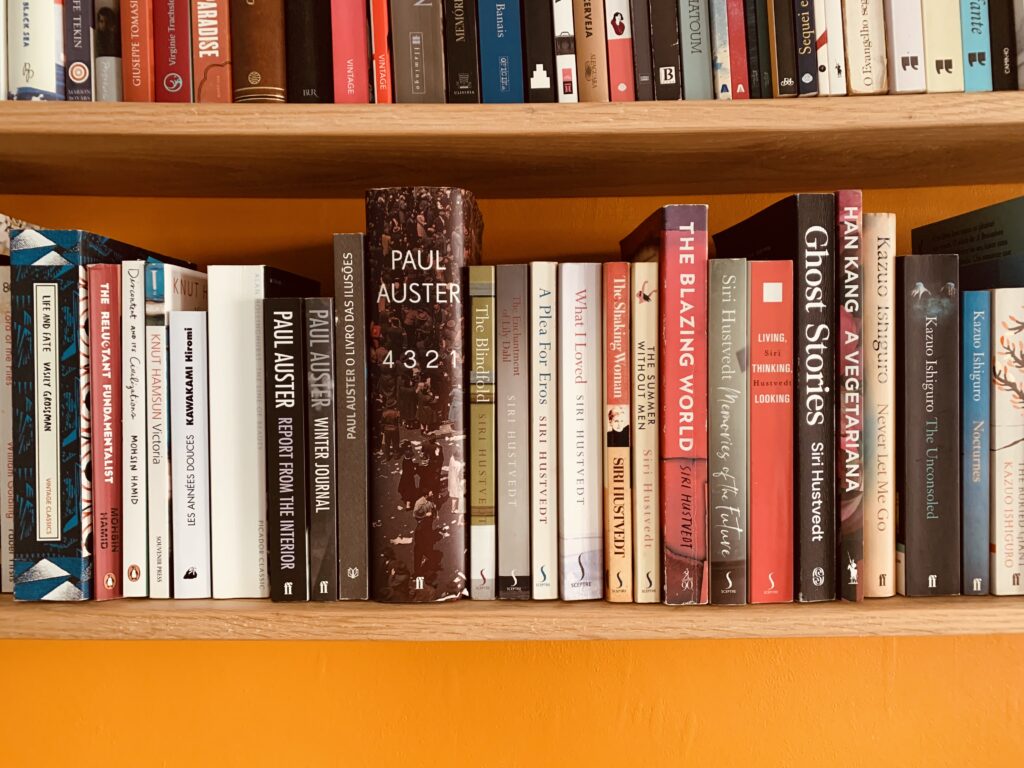
I saw Siri Hustvedt twice in Lisbon, about 15 years ago, once at a small gathering at the University of Lisbon (?) and another time when she was accompanied by Paul Auster and the South African writer and Nobel Prize winner for Literature, J. M. Coetzee. I hope to see her in person again. I hope to be able to keep reading her and listening to her for many more years. At one time, the books I have by the author sat side by side with those by Paul Auster, but when I reorganised my book collection in alphabetical order, they ended up further apart. After reading Ghost Stories, I looked at my bookshelf again: her books belong as close together as possible, just as they so loved to be with one another.