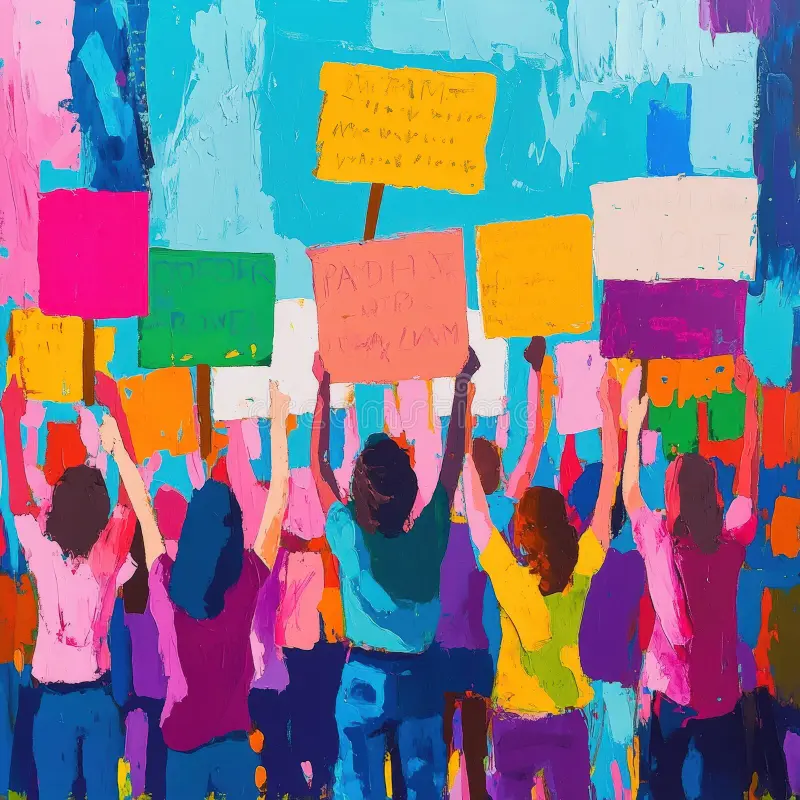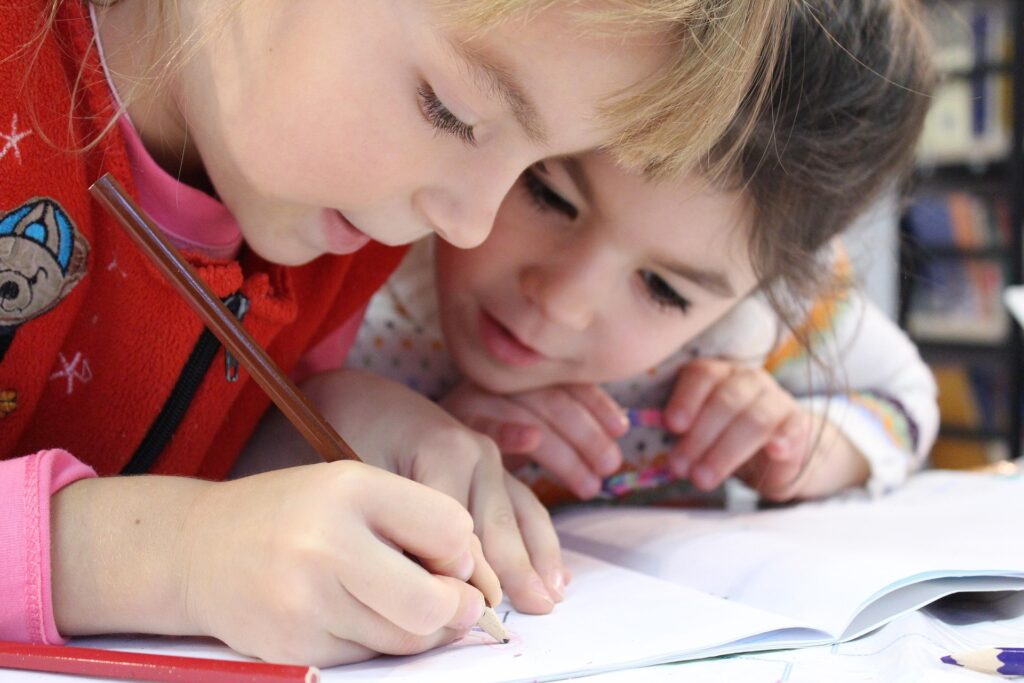

There are a variety of questions and observations I have made over the years about the state of childhood and education through my work experiences in the child rights’ field, as a mother and, not less important, as a member of this family we call humanity. For years, I have worried about the impact of modern life on childhood and, in relation to that, the inadequacy of schools (and societies at large) to respond to the child’s developmental needs and to prepare children for the questions that we are faced as humans. In recent years, with the advancement of technology, in particular, Artificial Intelligence (AI) and the impact of climate change, I have grown more and more concerned. There is no stopping the advancement of technology, especially now that AI is fully operational, unless we exhaust the Planet’s resources in the meantime. The issue is not can machines do it, but rather what can they not do? The possibilities seem endless. And now that we are here in this time of history, the question we must ask ourselves is: what must humans become? In other words, who do we want to be as a society or in simpler terms, in what kind of a society do we want to live in? And after we have asked ourselves that, the next question must inevitably be: how do we get there?
To answer to the first question, what must humans become, we best ask children, for they know it better. A child would say: “I want to be well and happy.” A child’s definition of well-being is usually very sensible: having a house and a family, spending time with family and friends; and being in nature. And, it is safe to assume, no child would want to live in fear or through the horror of conflict. A happy and peaceful society seems like a good place to aim at and strive. And, as this is the space to dream, I would like to ask for people to become wise and learn how to live well with themselves, with others and in harmony with nature.
As to the how do we get there, the only intervention at societal level that can lead to a meaningful turn of things is learning and education. In some ways, the destiny of the society where we as adults live in has already been decided, but it does not have to be so for the next generations. We can come together today and imagine what we would want for their future.
To open the discussion about where we may go with education, it is important to first reflect back on what has brought us to this point in time. Modern Education has its origins in the Industrial Revolution and not as much as we may think has changed since then. At the time, with the advancement of factory work, employers needed labour hand that had minimum reading and arithmetic skills to carry out the necessary tasks. The level of knowledge required of a student in 19th century England cannot be compared to the knowledge required of and acquired by students in today’s developed world. However, the ultimate goal is similar: to train future workers and augment productivity and profit. So, in practice, the central education goals do not greatly differ today from those of two hundred years ago and so another question must be made: how can education not have changed significantly, when the world has changed so much? Moreover, with the rapid advancement of technology, in particular AI, it continues to change at a pace and with an impact that humans and societies are not prepared to face. There are almost two hundred active conflicts in the world, with new and more lethal weapons being used. The gap between rich and poor is growing deeper and we are only witnessing the beginning of the harm caused by climate change and the breach of other planetary boundaries. The challenges the new generations are faced with are gigantic and, as adults, our role must be to prepare them for it. Education’s goal cannot continue to be to produce more, if anything, it is the massive production that has brought us to today’s problems. Education must respond to the challenges that we all face as humanity but it can also have higher societal goals.
At a practical level, we will need: a) to address the overall goal of education; b) to consider the way schools are organised; c) to review the set of skills and competencies are explored in schools; and d) to consult with children and teachers.
The way schools are planned and organised in the majority of countries is inadequate to today’s world. The first wrong assumption upon which education systems are based is that it is training “adults in the making”. Instead, education systems should first be planned and organised around the needs and characteristics of children, their developmental stages and as a means to nurture their own personality. Secondly, education systems should aim to guide its younger citizens to live in a shared world, in harmony with other citizens and in the respect for nature. The United Nations Convention on the Rights of the Child, adopted in 1989 and ratified by all countries in the world except the United States of America, in is Article 29(1), states that the aims of education are, among other:
“The development of the child’s personality, talents and mental and physical abilities to their fullest potential (29.1.a); The preparation of the child for responsible life in a free society, in the spirit of understanding, peace, tolerance, equality of sexes, and friendship among all peoples, ethnic, national and religious groups and persons of indigenous origin (29.1.d); (and) The development of respect for the natural environment (29.1.e) (1).”
All countries that have signed this important treaty are bound by its articles and principles, but it is safe to say that, in the 30 plus years of its implementation, virtually no country in the world has achieved the aims of education.
The second wrong assumption is that intelligence is enough. The education system and the workplace have been built upon the skills and competencies related to the intelligence quotient (IQ). We have even made tests for it. We have punished students, even young children, both through the grading systems, but also, until recently, physically, because they would not learn and, above all, perform. But cognitive intelligence on its own cannot contribute to all types of societal roles, even in the workplace, let alone human fulfilment, social cohesion or peace. We promote competition in schools from a very young age, to then spend years and resources at work, investing in teambuilding and trying to enhance the social and collaborative skills that, as students, people were not able to acquire. A highly competitive system cannot teach teamwork. We pretend to live in democracies, but do not embed philosophy, ethical judgement or democratic values in schools. Children have very little choice about what, when and how they study; and many of them find school uninteresting and unfair. Also, intelligence alone is not a predictor of success. On the contrary, many successful entrepreneurs, the like of which our societies have come to worship, had poor academic performance. Vision, the capacity to nurture teams and ideas themselves do not come from repetition, memorisation and testing, but from other inner and external spaces, including nurturing creativity and the possibility to learn in different ways.
Furthermore, modern education systems face various challenges. I would like to point out two. The first and possibly more obvious one is that the cognitive competencies that are required from students at school, including proficiency and efficiency in mathematics, languages or physics have been surpassed by the capacity of AI. Machines can do more, better and faster. The second issue that we must confront ourselves with is that the education system as it has been designed and delivered has failed to prevent polarisation, conflict and other social and human crisis, such as loneliness, depression, burnout and mistrust. If we consider these as failures, they are not primarily failures of intelligence, they are, above all, failures of human understanding. At an individual level, despite prosperity, modern times have also enhanced mental health issues, including children and young people reporting anxiety related to climate change (2). At a collective level, in the last few years, even in Europe where democracy was well-established, we have witnessed the growth (in both number of initiatives and support) of extreme-right movements, mistrust against others (in particular refugees and migrants) and general polarisation. In parallel, as abovementioned, we have entered the greatest challenge that human societies as we have known them for tens of thousands of years: the breach of the planetary boundaries. In short, we are destabilising, through our human activity, the very environment that has allowed human life to prosper.
Finally, we have not embedded the opinions of children and teachers, as well as other relevant school professionals, as a basis to change and improve education. In accordance to the Convention on the Rights of the Child, children have the right to express their views in all matters that are relevant to their lives (Article 12). The so-called children’s right to participation has evolved over the last three decades, from a tokenistic understanding in the early stages to a child-centred approach. Some modern school approaches include some levels of child participation (i.e. class time or ad hoc consultations). In 2019, Ireland became the first country in the world to adopt a National Strategy on Children and Young People’s Participation in Decision-Making specifically dedicated to embedding child participation across all relevant sectors, including education (3). Despite some advancements in this area, overall, children do not have a say about how schools are designed, the content of school curricula or other aspects related to their own education.
So, in this context, assuming we want to continue prospering as humanity and societies and that we will (also) continue living alongside machines, we must inevitably ask ourselves a few crucial questions. The first questions must be linked to the overall aims of education, as discussed above. A second set of questions must be posed in relation to AI, namely what can the machine do and what can a worker or a student, do (that the machine cannot do)? Can one complement the work of the other? And, more importantly, how can technology and AI be used to improve people’s lives?
What makes us unique and what can make us advance as humanity is our ability to feel emotions. This distinguishes us especially from AI machines. Empathy, love, friendship and compassion, among many other emotions, are a form of knowledge. I would like to focus specifically on empathy.
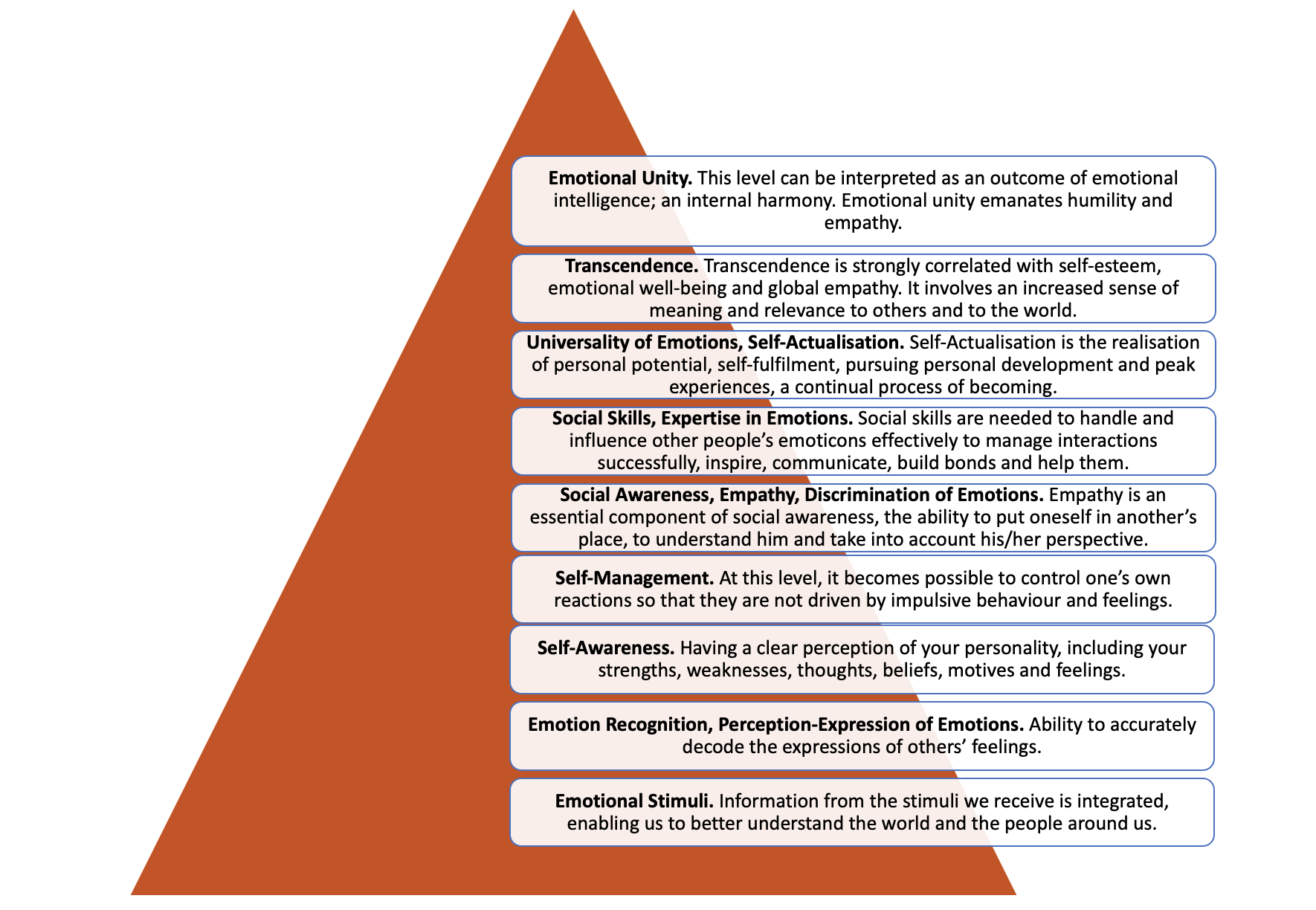
Authors Drigas and Papoutsi have proposed a nine-layer pyramid to describe the different stages and development of emotional intelligence (4). In their proposal, empathy can be found in the fifth layer starting from the bottom, demonstrating the complexity of identifying, understanding, managing and using emotions to advance one’s life and to relate to others. Empathy itself is described in the article as the most important component of social awareness and is understood as:
“(…) the ability to put oneself in another’s place (or “shoes”), to understand him as a person, to feel him and to take into account this perspective related to this person or with any person at a time. (Furthermore), with empathy, we can understand the feelings and thoughts of others from their own perspective and have an active role in their concerns. The net result of social awareness is the ongoing development of social skills and a personal continuous improvement process (3).”
Empathy is also the path towards a more developed emotional intelligence and can have a very important role, both at an individual and at a collective level. The nine-layer pyramid, which is illustrated below shows how emotional intelligence, based to a great extent on empathy, can be enhanced as a means to achieve individuals’ human potential, a “global conscience” and harmony within and between humanity and the natural world.
All humans are born with emotions, but to understand, manage and use them to improve one’s life and our relationships with others, as well as, the awareness of the wider world is something that one acquires, often through practical work. This is the example of “Class time” (in the original klassens tid), an educational strategy introduced in 1993 by the Danish government in its “Law on Education”, which aims to:
“Promote students’ engagement in their own mental development by increasing their knowledge about each other and themselves, and thus work for a better mutual understanding and acceptance of everyone – an aspect is to have empathy (5).”
Nowadays, Klassens tid is generally treated as a routine feature of Danish school culture rather than a formal intervention or programme because, as it happens in other Scandinavian countries, democracy, alongside child development are central features of the education systems. Indeed, education systems in different countries have been using empathy and empathic education as an education strategy to promote democracy, environmental awareness or in the context of emotional intelligence classes.
Another recent example comes from Colombia. On 13th of November 2025, the government approved the so-called “Law of Empathy” with the aim to “to raise environmental awareness and promote a culture of respect for animals and ecosystems from an early age (6).” Law 2563 of the 29th of December further stated that:
“The curricular and pedagogical guidelines required for the implementation of the approaches discussed in this article must take into account, as a minimum, the interdependence between the ethical treatment of animals, their protection and welfare, the care and conservation of biodiversity, the balance of ecosystems, and the health and well-being of human beings and their environment (7).”
These examples are useful to demonstrate how empathy can be embedded in education systems and bring positive results. The idea is to go beyond “empathy classes” and aim to build education systems that are centred around the needs and characteristics of children, respect for human values and nature, democracy and peace.
Therefore education should cultivate empathy alongside:
- General emotional intelligence as discussed above, including self-awareness, social skills and a global conscience;
- Moral, philosophical and ethical reflection; and
- Mutual understanding and collaboration, among other.
We need to imagine a broader approach to education and to use existing pedagogies and pedagogical approaches, both old ones such as those proposed by Maria Montessori (Italy), Rudolf Steiner (Austria), or Paulo Freire (Brazil) and modern ones; and to design schools with children, democracy and the principle of harmony with the Planet at the heart of education. Indeed, distinct approaches to education have been developed and could be implemented. The planning and organisation of education should take into account pedagogical approaches that promote the understanding of child development amongst education professionals, a focus on the child’s holistic development (and not performance), collaboration and dialogue amongst students and between children and adults, arts and creative expression, community and democratic values, and cross-cultural encounters.
AI is rapidly changing the equation. As teachers have found for some time now, children are using machines to do their homework, including to solve mathematical problems, retrieve information, generate text, and other. So, AI is already doing it for us and, as stated above, they can do it better. AI may even provide us with the solutions to face humanity’s big problems, to act as a therapist, coach or “friend”. But ultimately, AI does not live the human experience. If we want to continue inhabiting Planet Earth and to prosper, we must learn to live better with each other, to build trust, end war for once and for all; and to take the necessary (and difficult) steps to address climate change and other dramatic problems facing humanity. We must learn to adopt different lifestyle habits, such as the Planetary Health Diet (8), to develop inner strength and fulfilment, to reduce consumerism and to value human, animal and natural life. AI cannot replace us in the teaching or learning of any of this. It may help us to identify solutions, but it is up to us to change our own world. The education systems must shift their goals from information acquisition to human formation, in the name of all people and the greater good. Empathy, not intelligence, will achieve this.
Translated from English to Portuguese and French with Deepl.com (Free version)
References
(1) Convention on the Rights of the Child. 1989
(2) Hickman, C., Marks, E., Pihkala, P., Clayton, S., Lewandowski, R. E., Mayall, E. E., Wray, B., Mellor, C., & van Susteren, L. (2021). Climate anxiety in children and young people and their beliefs about government responses to climate change: a global survey. The Lancet. Planetary health, 5(12), e863–e873. https://doi.org/10.1016/S2542-5196(21)00278-3
(3) Department of Children and Youth Affairs. (2019). National Strategy on Children and Young People’s Participation in Decision-Making 2015–2020 (mid-term review and strategy document). Government of Ireland
(4) Drigas, A. S. and Papoutsi, C. (2018) A New Layered Model on Emotional Intelligence. Behav. Sci. 2018, 8, 45; doi:10.3390/bs8050045
(5) Iben Dissing Sandahl (2017) The Danish Way: “Klassens tid”. Aspects of Building Democracy in Danish Schools. Ehrhorn Hummerston. Denmark. Copenhagen
(6) Colombian Congress. Aprobada “Ley Empatía”: educación ambiental con enfoque de bienestar animal para colegios del país. 13/11/2025 https://www.camara.gov.co/aprobada-ley-empatia-educacion-ambiental-con-enfoque-de-bienestar-animal-para-colegios-del-pais/ (Last accessed June 16 2026)
(7) Colombian Congress. LEY 2563 DE 2025 (diciembre 29) por la cual se reconocen e integran los enfoques de Protección, Bienestar Animal y Conservación de la Biodiversidad en el marco de la Política Nacional de Educación Ambiental y se dictan otras disposiciones: Ley Empatía. https://www.suin-juriscol.gov.co/viewDocument.asp?id=30055963 (Last accessed June 16 2026)
(8) Rockström, J., Haraksingh Thilsted, S., C Willett, W., J Gordon, L., Herrero, M., C Hicks, C., Mason-D’Croz, D., Rao, N., Springmann, M., Cecilie Wright, E., Agustina, R., Bajaj, S., Charlotte Bunge, A., Carducci, B., Conti, C., Covic, N., Fanzo, J., G Forouhi, N., F Gibson, M., Gu, X., … DeClerck, F. (2025) The EAT–Lancet Commission on healthy, sustainable, and just food systems. Lancet, 406: 1625–700. https://doi.org/10.1016/S0140-6736(25)01201-2